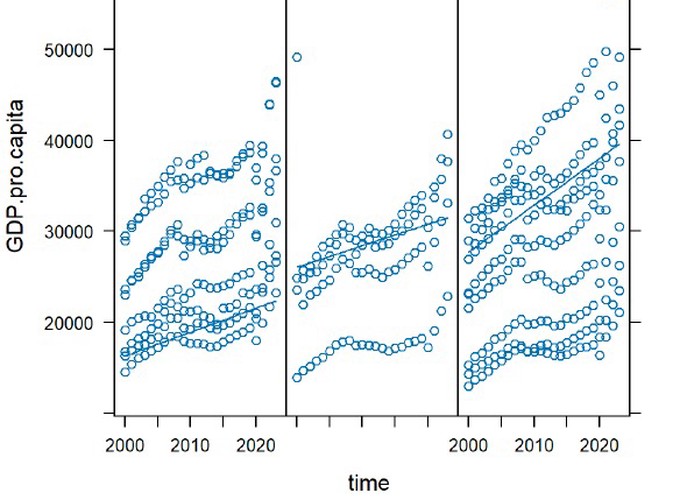
This project explores whether climate change exacerbates economic and social disparities between northern and southern Italy, combining socioeconomic indicators, climate data, and advanced statistical modelling.
Data were collected from Eurostat, Copernicus, and ISTAT for the period 2000–2023, harmonized at the NUTS2 regional level.
After data cleaning and integration, a hierarchical mixed-effects model was fitted to investigate the relationship between GDP per capita and multiple climatic and demographic predictors, including temperature, precipitation extremes, wind speed, fertility rate, life expectancy, and employment rate.
The model incorporated random intercepts and slopes for Italian regions, allowing for heterogeneity across the North, Centre, and South.
Main Results
- Climate change acts as a multiplier of pre-existing regional inequalities.
- Southern regions exhibit negative random slopes, indicating slower or negative economic growth relative to the North.
- Extreme precipitation, mean wind speed, and fire weather index significantly and negatively affect GDP per capita.
- A breakpoint analysis on national temperature series showed a structural change in 2013—before the Paris Agreement—suggesting no measurable effect yet from international climate policy.
Methodology
- Random-effects linear models with zone- and region-specific effects (
nlmepackage) - Multicollinearity analysis and variable selection (
corrplot) - Geospatial visualization of GDP and temperature trends (
ggplot2,sf,giscoR) - Breakpoint detection for temperature time series (
strucchange) - Data imputation via the LOCF (Last Observation Carried Forward) method
Data Sources
- Eurostat: agriculture, economy, education, and tourism data
- Copernicus: climate and environmental variables
- ISTAT: demographic and migration statistics
Downloads
This project demonstrates how integrating climate and socioeconomic data through advanced modelling can reveal subtle but significant disparities in resilience and adaptability across regions, providing a statistical foundation for evidence-based climate policy in Italy.